

There is no single best door lock for every home in Battersea.
A Victorian timber front door, a converted-flat entrance, a uPVC door and a modern apartment entrance can all require very different locking systems.
That means choosing a lock should start with the door and property type, not simply with the strongest-looking product.
A good lock fitted to the wrong door can cause problems. A high-security cylinder also cannot compensate for a weak frame, badly aligned door or damaged mechanism.
If you need help with an existing lock rather than general advice, our Battersea locksmith service covers lock repairs, replacements and emergency problems across SW11.
Start With the Door, Not the Lock
Before deciding whether a lock should be replaced or upgraded, look at the whole entrance.
Consider:
- the door material
- the existing lock type
- the condition of the frame
- whether the door closes correctly
- whether the lock is becoming stiff
- how the property is used
- whether the entrance is part of a managed building
- any relevant insurance requirements
The right lock for one Battersea property may be completely unsuitable for another a few streets away.
Victorian and Edwardian Houses in Battersea
Battersea has many older houses with timber entrance doors.
These commonly use combinations of traditional locking hardware such as:
- mortice deadlocks
- mortice sashlocks
- night latches
- rim locks
A traditional timber entrance door can provide good security when the lock, frame and installation are all suitable.
The mistake is looking only at the lock.
If the door frame is damaged, loose or heavily worn, fitting a stronger lock does not fix the entire security problem.
The lock and door need to work together.
What Is a Mortice Lock?
A mortice lock sits inside a pocket cut into the edge of a timber door.
Two common forms are the mortice deadlock and mortice sashlock.
A mortice deadlock generally operates a locking bolt using a key.
A mortice sashlock also incorporates a latch, allowing the door to remain closed without the bolt being locked.
Mortice locks remain common on traditional London entrance doors.
If an existing mortice lock becomes difficult to operate, replacement is not automatically necessary. The problem can sometimes relate to door alignment, strike position or wear elsewhere in the installation.
What Does BS3621 Mean?
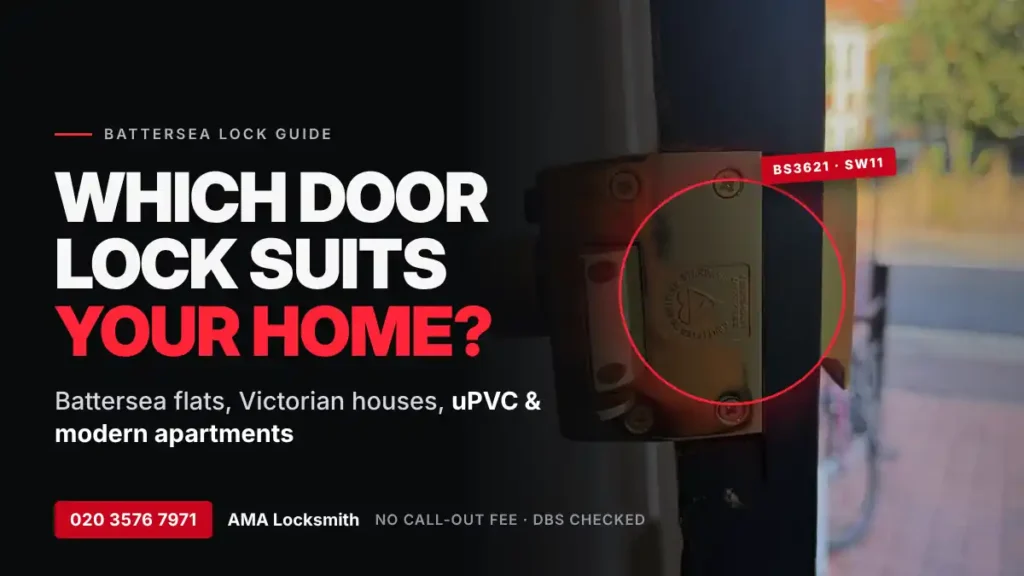
You may see BS3621 mentioned when comparing locks for external timber doors.
It is a British Standard associated with thief-resistant mechanically operated locks.
For some homes, an insurer may specify a lock meeting a particular standard or an equivalent security arrangement.
However, insurance requirements are not identical for every policy.
Homeowners and landlords should check the wording of their own insurance rather than assuming that an online recommendation applies universally.
A locksmith can identify the existing lock and discuss appropriate replacement options where necessary.
Night Latches on Battersea Front Doors
Night latches are common on many London timber doors.
They are convenient because the door can latch automatically when it closes.
That convenience is also one reason accidental lockouts happen.
You step outside, the door closes, and the keys are still inside.
A night latch can form part of a suitable security setup, particularly when combined with other appropriate locking hardware.
But there are many types and security levels, so the existing installation needs to be assessed rather than treating every night latch as identical.
If that automatic latching has already left you outside, our guide explains what to do when you’re locked out in Battersea.
Converted Flats Need a Different Approach
Converted houses are common around Battersea.
These properties can have several layers of entrance security:
- a communal front entrance
- an individual flat entrance
- original timber doors
- replacement doors
- older mortice locks
- newer cylinders or night latches
That mixture means a lock should not be replaced without first understanding the particular door.
The communal entrance may also be managed separately from the individual flat entrance.
If the issue concerns shared-building access, it may be a matter for the landlord, freeholder or managing agent rather than the individual resident.
Flat Entrance Doors Can Also Be Fire Doors
This is particularly important in blocks of flats.
An individual flat entrance door may form part of the building’s fire-safety arrangements.
That means changes to:
- locks
- handles
- door closers
- glazing
- door furniture
- the door itself
need to be considered carefully.
Government fire-safety guidance states that flat entrance doors play an important role in limiting the spread of fire and smoke into communal areas. Residents should also avoid interfering with self-closing devices and should involve the relevant responsible person where alterations could affect the door’s fire performance.
So a lock upgrade should not accidentally compromise the wider door assembly.
Mansion Blocks and Purpose-Built Flats
Traditional purpose-built blocks can have very robust timber entrance doors.
Common configurations may include mortice locks, night latches or combinations of both.
The age of the property alone does not determine whether the lock needs replacing.
A well-installed existing lock in good condition may still be appropriate.
What matters is:
- condition
- reliability
- door construction
- frame strength
- suitability for the property
If the lock is becoming stiff or unreliable, deal with that fault before simply adding more security hardware.
Our guide to a key that won’t turn or a jammed lock in Battersea explains the common warning signs.
Modern Apartments Around Battersea Power Station
Modern developments around Battersea Power Station and neighbouring areas can use very different entrance hardware from older Battersea houses.
Depending on the door specification, you may encounter:
- euro-profile cylinders
- thumbturn cylinders
- multipoint locking systems
- specialist apartment entrance hardware
- electronic communal access
It is important not to assume that the visible cylinder is the entire lock.
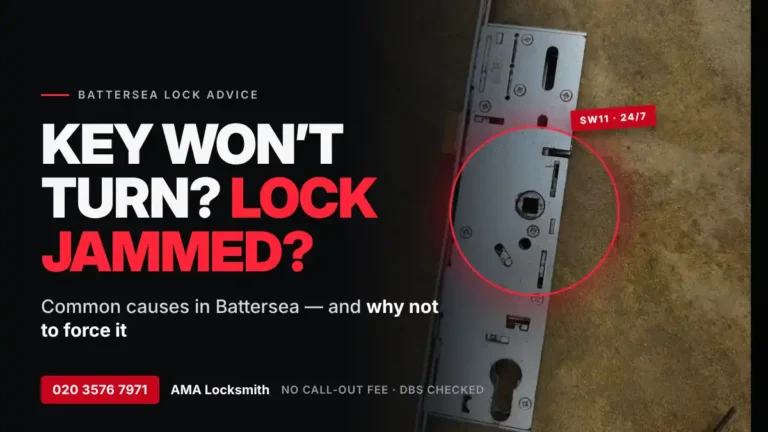
A modern entrance door can contain a much larger mechanism.
If the door becomes difficult to lock, the cylinder may be perfectly functional while the actual fault sits elsewhere in the mechanism.
Euro-Profile Cylinders
Euro cylinders are widely used in modern doors.
They are available in many different:
- lengths
- security specifications
- key configurations
- thumbturn configurations
Correct sizing matters.
A cylinder that projects too far beyond the surrounding hardware can create an unnecessary security weakness.
When replacing a euro cylinder, the surrounding handles, door construction and locking mechanism should therefore be considered at the same time.
What Are Anti-Snap Cylinders?
Anti-snap cylinders are designed to provide additional resistance against a known method of attacking certain euro cylinders.
They can be a worthwhile upgrade on suitable doors.
But an anti-snap cylinder is not a complete security system on its own.
Overall door security also depends on:
- handles
- frame
- hinges
- multipoint mechanism
- installation quality
- other vulnerable areas
It does little good fitting a premium cylinder if another part of the entrance is badly damaged or insecure.
uPVC and Composite Doors
uPVC and composite doors commonly use multipoint locking mechanisms.
When you lift the handle, several locking points engage around the door.
The cylinder then secures that mechanism.
This distinction matters because people often refer to the entire system as “the lock”.
In reality there can be separate components including:
- euro cylinder
- handles
- spindle
- gearbox
- multipoint strip
- hooks or rollers
- keeps in the frame
If the door has become difficult to lock, simply changing the cylinder may achieve nothing.
What Is the Best Lock for a uPVC Door?
There is no universal answer.
The correct setup depends on the existing door and mechanism.
Before deciding on an upgrade, assess:
- cylinder size and specification
- handle condition
- gearbox condition
- multipoint mechanism
- alignment
- frame condition
- how smoothly the door closes
If the door only locks when you lift it hard or push against the frame, the problem may be alignment rather than security.
Replacing the cylinder would not correct that.
Signs a Multipoint Lock Needs Attention
Watch for:
- stiff handle
- key becoming difficult to turn
- door needing to be lifted
- locking points failing to engage
- handle moving without operating the mechanism
- key turning while the door remains locked
- unusual clicking or grinding
These symptoms should be investigated before the system fails completely.
Our Battersea emergency locksmith page explains how multipoint and uPVC door faults are handled across Battersea and SW11.
Should You Upgrade a Lock After Moving Home?
This depends on the circumstances.
When moving into a new home, you may not know how many copies of the existing keys remain in circulation.
Previous:
- owners
- tenants
- contractors
- cleaners
- agents
may at some point have held keys.
Replacing the relevant cylinders or locks can therefore provide better control over who has access.
But that does not necessarily mean replacing every piece of door hardware.
Often it is possible to retain suitable hardware and replace only the component that controls key access.
Lost or Stolen Keys
Similar reasoning applies when keys are missing.
If a key is lost somewhere with no identifying information, the risk may be relatively limited.
If it is stolen or lost together with something that identifies the property, replacing the relevant lock may be sensible.
The response should reflect the actual risk rather than automatically carrying out unnecessary work.
Should You Add More Locks to a Timber Door?
More locks do not automatically mean better security.
A door with several poorly fitted locks can still be weaker than a door with one or two appropriate locks installed correctly.
Adding more hardware can also weaken a timber door if it is badly positioned.
Look at the entrance as one system:
door + frame + locks + hinges + installation.
Security is only as strong as the important weak points.
What About Smart Locks?
Smart locks can be useful, but they are not automatically an upgrade.
Before fitting one, consider:
- compatibility with the door
- mechanical backup
- battery failure
- emergency access
- other people who need access
- building-management rules
- fire-door implications
- long-term support for the device
In a managed block, the individual flat entrance may also be subject to requirements that do not apply to an ordinary house door.
Do not modify a fire-rated entrance solely for convenience without checking whether the hardware is suitable.
Locks for Battersea Landlords
Landlords and letting agents may need lock work:
- between tenancies
- after keys go missing
- following attempted burglary
- when a lock becomes unreliable
- after a tenant reports an access problem
The aim should be reliable, secure access using hardware appropriate to the property.
In managed blocks, the individual entrance should also remain compatible with any relevant building requirements.
Commercial Doors in Battersea
Shops and offices can have different requirements from homes.
Commercial premises may experience heavier daily usage and may use:
- different cylinders
- commercial-grade locks
- specialist door hardware
- access-control equipment
The best solution depends heavily on the existing entrance and how frequently it is used.
Residential recommendations should not simply be copied onto a commercial door.
Repair or Replacement?
A lock upgrade is not always necessary simply because a lock has developed a problem.
Repair may be appropriate when:
- the existing lock is suitable
- the fault can be corrected reliably
- components remain available
- security has not been compromised
Replacement may make more sense where:
- the lock is badly worn
- parts are unavailable
- the cylinder is damaged
- keys can no longer be accounted for
- the mechanism has failed repeatedly
- the existing security is inadequate
The key question should be:
what problem are we trying to solve?
Before Choosing a New Lock
Check:
- door type
- door condition
- frame condition
- existing lock
- whether the door closes correctly
- whether the lock is actually faulty
- key control
- insurance requirements
- whether it is a fire door
- whether the building has management requirements
Doing this first avoids replacing hardware unnecessarily.
A Simple Battersea Property Guide
Victorian or Edwardian timber entrance
Look at the existing mortice lock, night latch, frame and overall installation.
Converted flat
Consider both the individual flat entrance and any communal access arrangements.
Mansion block or purpose-built flat
Check the existing door hardware and whether the entrance forms part of a fire-safety arrangement.
Battersea Power Station or modern apartment
Assess the cylinder alongside the wider door mechanism and building requirements.
uPVC or composite entrance
Assess the entire multipoint system rather than focusing only on the cylinder.
When Security Upgrades Make Sense
An upgrade may be appropriate if:
- an existing lock is clearly inadequate
- a cylinder has been damaged
- keys have been stolen
- there has been a burglary attempt
- the lock is repeatedly failing
- you want better key control
- existing hardware no longer suits the property
A security upgrade should have a clear reason behind it.
Replacing functioning hardware simply because a product is newer is not always necessary.
Need Advice About a Door Lock in Battersea?
AMA Locksmith provides lock repair, replacement and security work throughout Battersea and SW11.
If you are considering changing a lock, we can assess the existing door and explain whether repair, replacement or an upgrade is appropriate.
For emergency lockouts or failed mechanisms, visit our emergency locksmith service in Battersea.
If the problem is a lock becoming stiff or a key no longer turning properly, read our guide to jammed locks and keys that won’t turn in Battersea.
And if the door has already closed and you cannot get inside, see what to do when locked out in Battersea.
Call 020 3576 7971
Call or WhatsApp 07752 270463
24/7 Emergency Service · No Call-Out Fee · Fully Insured · DBS Checked · Speak Directly to the Locksmith