

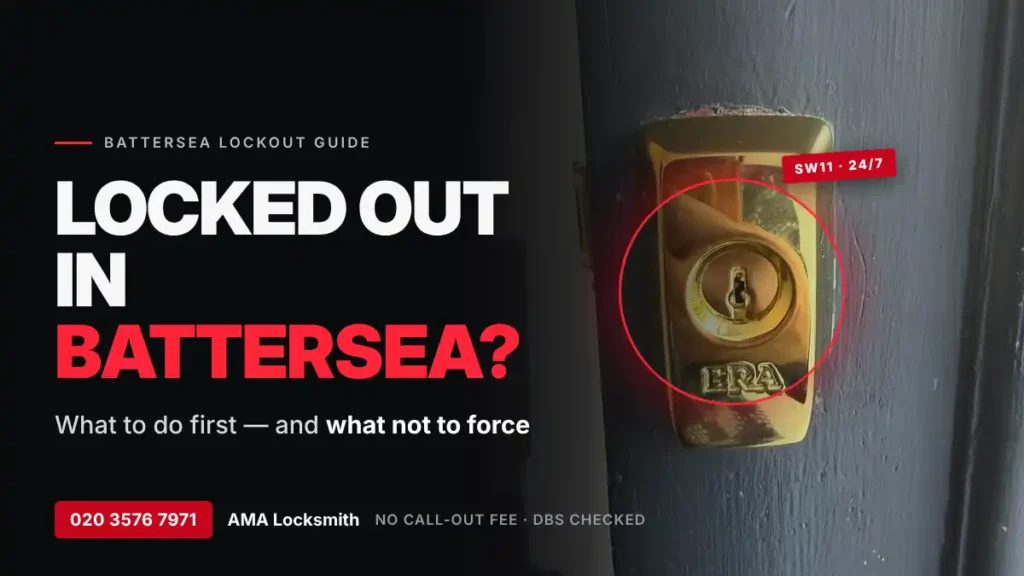
Getting locked out can happen in seconds.
You step outside and the door closes behind you. You arrive home and realise your keys are missing. Or the key is in your hand, but the lock suddenly refuses to open.
The important thing is not to make the problem worse.
A door that has simply latched shut is a very different problem from a snapped key, failed mortice lock or broken multipoint mechanism.
If you are locked out in Battersea or SW11, the safest next step depends on what has actually happened to the door and lock.
If you need immediate help, our emergency locksmith service in Battersea covers SW11, including Battersea Park, Battersea Power Station, Lavender Hill and Clapham Junction.
First, Work Out What Has Happened
Before trying anything, think about the last thing the door did normally.
- Did it simply close behind you?
- Did you turn the key before leaving?
- Has the key been getting harder to turn recently?
- Did the handle feel stiff?
- Has part of the key broken inside the lock?
- Does the key turn but the door remain closed?
These details matter because they help distinguish a straightforward lockout from an actual mechanical failure.
A locksmith should diagnose the cause before deciding whether the door needs opening, the lock needs repairing or a component genuinely needs replacing.
Keys Locked Inside the Property
This is one of the most common lockout situations.
If the door has simply closed behind you and is not fully deadlocked, access may be more straightforward than you expect.
Do not immediately assume the lock needs drilling.
The right approach depends on:
- the type of door
- the type of lock
- whether the door is only latched
- whether another locking point has engaged
- whether the mechanism itself has failed
Where the situation allows, a locksmith may be able to use a non-destructive method to regain access.
That means trying to open the door without unnecessarily damaging the lock, door or frame.
This is also why repeatedly forcing the handle or trying random methods from online videos is rarely a good idea.
A simple lockout can become a damaged lock very quickly.
Lost Your Keys in Battersea?
Lost keys create two separate issues.
The first is getting back inside.
The second is whether anyone else could reasonably identify where those keys belong.
If the keys are genuinely lost and there is no realistic way to connect them to your address, changing the lock may not always be necessary.
If the keys were stolen, lost with identification or lost together with something showing your address, replacing the relevant lock may be sensible.
That decision should depend on the circumstances rather than automatically changing every lock in the property.
If a replacement is needed, it is better to choose the correct lock for the actual door rather than simply fitting whatever is closest to hand.
Key Snapped in the Lock
If the key has snapped inside the lock, avoid pushing the broken section deeper into the keyway.
Do not try to hook it out with knives, screwdrivers or other improvised tools.
A snapped key can sometimes be extracted while keeping the existing lock.
The outcome depends on:
- where the key has broken
- whether part of the key is still visible
- whether the lock is under tension
- whether the cylinder was already worn
- whether the broken piece has been pushed further inside
If the key had already become difficult to turn before it snapped, the broken key may only be the final symptom of a developing lock problem.
The lock should still be checked afterwards.
The Key Turns but the Door Will Not Open
This can be confusing because it feels as though the lock has unlocked.
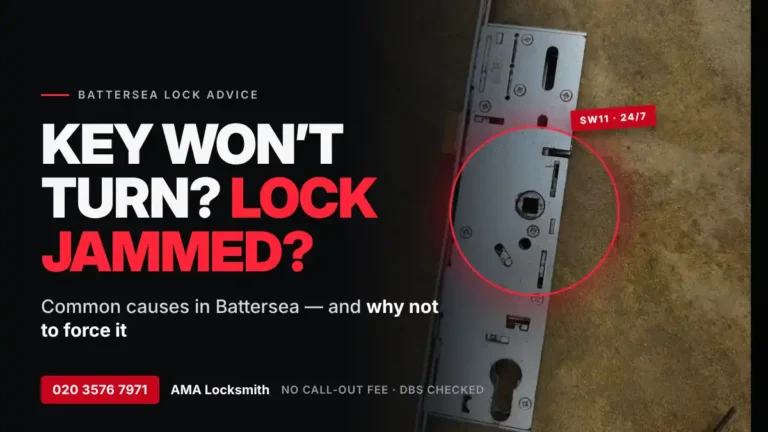
Sometimes the cylinder turns correctly but the latch, bolt or multipoint mechanism does not retract.
In other cases, the door is under pressure because it has moved slightly in the frame.
Warning signs before complete failure can include:
- needing to lift the handle harder than before
- pulling the door toward you while turning the key
- pushing the door firmly into the frame before it locks
- a key becoming progressively stiffer
- the lock only working when the door sits in a particular position
These symptoms are often signs of a developing fault rather than just an awkward lock.
If the key is becoming stiff or the lock is starting to jam, it is worth dealing with it before you end up fully locked out.
Do Not Keep Forcing the Key
This is one of the biggest mistakes people make.
If a key suddenly becomes stiff, increasing the pressure can cause:
- a bent key
- a snapped key
- a damaged cylinder
- internal lock damage
- gearbox damage on a multipoint system
A repairable problem can become a more complicated job after repeated force.
If the key feels very different from normal, stop.
A lock should not require excessive force to work.
Check Another Authorised Entry Point
If you have another legal and safe way into the property, check that first.
That could include:
- another door you normally use
- another household member with a spare key
- a trusted keyholder
- a landlord or managing agent who legitimately holds a key
Avoid climbing through unsafe windows or trying to force another entry point.
Injuring yourself or damaging another door is not a sensible solution to a lockout.
If You Rent the Property
If you are a tenant, it may be worth contacting your landlord or managing agent before calling a locksmith.
They may hold a spare key.
In managed blocks, some entrance systems may also fall under the responsibility of the building rather than the individual resident.
This can matter in newer Battersea developments.
If the problem concerns your individual flat entrance door, a locksmith can usually assess that door.
If it concerns the main communal entrance or an electronic building-access system, the managing agent may need to deal with it.
Battersea Power Station and Modern Apartment Lockouts
Modern apartment doors can use very different locking systems from older timber doors.
Depending on the building and door specification, you may encounter:
- euro-profile cylinders
- thumbturn cylinders
- multipoint mechanisms
- specialist flat entrance hardware
- controlled communal access
If a modern mechanism has failed internally, changing the cylinder alone may not solve the problem.
That is why diagnosis matters.
Our Battersea locksmith page explains the different door and lock types commonly encountered around Battersea Power Station and SW11 in more detail.
Victorian and Edwardian Homes in Battersea
Older Battersea houses often have a completely different setup.
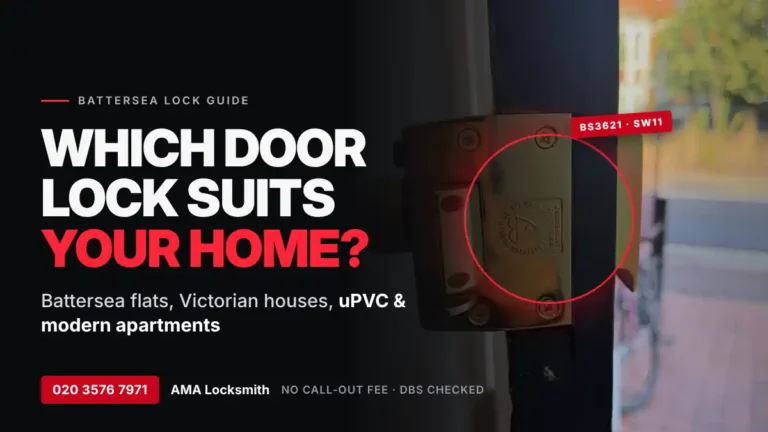
Timber entrance doors may use:
- mortice deadlocks
- mortice sashlocks
- night latches
- combinations of mortice lock and night latch
Age, movement in the door or frame and years of use can all affect how smoothly these locks operate.
If a door has started rubbing, sticking or needing extra pressure before it locks, that can contribute to future access problems.
The lock itself may still be serviceable.
The issue may be alignment, wear or a combination of both.
Converted Flats Can Be More Complicated
Converted properties can have a mixture of older and newer locking hardware.
You may have:
- a shared communal entrance
- an original timber front door
- a replacement flat entrance
- newer cylinders fitted into older hardware
That means the visible lock does not always tell the full story.
A locksmith needs to identify which locking point is actually causing the problem.
Should a Locksmith Drill the Lock?
Not automatically.
Drilling may sometimes be necessary, particularly where a lock has failed internally, is damaged or cannot reasonably be opened intact.
But it should not be the default answer to every lockout.
The method used should depend on:
- lock type
- door type
- security setup
- reason for the lockout
- condition of the mechanism
Where a suitable non-destructive method is available, that should normally be considered first.
What Information Should You Give the Locksmith?
A few useful details can make the call much easier.
Tell the locksmith:
- where you are in Battersea
- whether the door simply shut or was locked
- whether you still have the key
- whether the key turns
- whether the handle moves normally
- whether a key has snapped
- whether the lock had already been stiff
- what type of door you appear to have
A photograph can also help if it is practical to send one.
You do not need to know the technical name of the lock.
A clear description is usually enough to start.
You May Need to Show That You Are Authorised to Enter
A responsible locksmith should be satisfied that the person requesting entry has authority to access the property.
If your identification is locked inside, explain that when you call.
There may be other reasonable ways to establish occupancy or authorisation depending on the circumstances.
This is particularly important for rented homes, shared accommodation and managed apartment buildings.
How Long Does It Take to Open a Locked Door?
There is no honest answer that applies to every door.
A simple latched-door lockout can be very different from:
- a failed mortice lock
- a high-security cylinder
- a damaged multipoint system
- a badly misaligned door
- a lock someone has already attempted to force
The safest approach is to diagnose the problem first rather than promise every job will take the same amount of time.
The actual opening time depends on the hardware and fault.
How Much Does a Lockout Cost in Battersea?
The cost can depend on:
- the type of lock
- the type of door
- whether the door is latched or fully locked
- whether the lock has failed
- whether replacement parts are required
- the method needed to regain access
- the time and complexity of the work
A straightforward lockout and a failed multipoint mechanism are not the same job.
AMA Locksmith operates with no call-out fee, and the required work can be explained before proceeding.
What to Do While You Wait
Keep things simple.
Do:
- stay somewhere safe
- contact another authorised keyholder if available
- gather identification or proof of occupancy where practical
- explain any urgent safety issue when you call
- keep your phone available
Avoid:
- repeatedly forcing the handle
- twisting the key harder
- pushing objects into the lock
- kicking or shouldering the door
- attempting risky access through windows
When a Lockout Is Really a Lock Failure
Sometimes the problem is not that you have lost access.
The lock itself has stopped working.
Signs include:
- key will not turn
- key turns but the door stays locked
- handle is suddenly very stiff
- mechanism will not engage
- door only works when lifted or pushed
- key is difficult to remove
If you notice these symptoms before complete failure, dealing with them early can prevent a full lockout.
Our next guide covers why keys become stiff and locks jam in Battersea homes and flats, including alignment, cylinder problems and multipoint faults.
Locked Out in Battersea Right Now?
AMA Locksmith provides 24/7 locksmith assistance across Battersea and SW11.
You speak directly with the locksmith dealing with the job rather than a national call centre.
For urgent help, visit our emergency locksmith Battersea page or call directly.
Call 020 3576 7971
Call or WhatsApp 07752 270463
24/7 Emergency Service · No Call-Out Fee · Fully Insured · DBS Checked · Speak Directly to the Locksmith